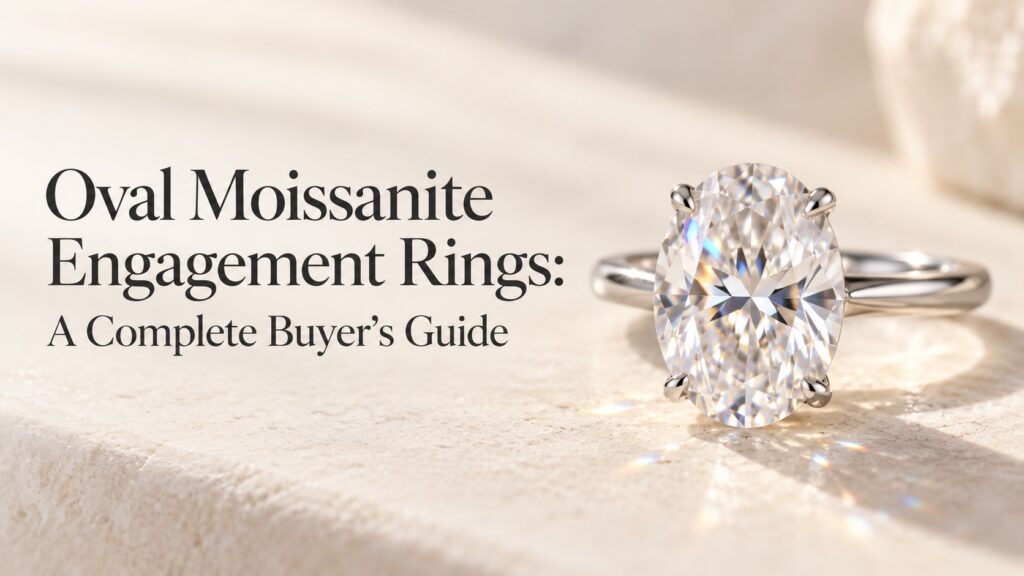
Oval moissanite engagement rings combine an elongated outline with the bright, colorful sparkle that makes moissanite distinctive. The oval shape can give a ring generous finger coverage, while the stone’s lively flashes make it stand out in changing light. The best choice depends on more than a carat label: compare the stone’s millimeter dimensions, length-to-width ratio, center brightness, setting, and how the ring looks in real video.
This guide answers the questions shoppers commonly raise when comparing oval moissanite rings: What ratio looks balanced? Do ovals have a bow tie? Does moissanite look like a diamond? Which size and setting work for daily wear? For a broader overview of shapes and styles, visit our moissanite engagement rings guide.
At a glance
- Shape: An oval brilliant has a rounded, elongated outline and a finger-lengthening appearance.
- Starting ratio: Around 1.35–1.50 is a useful range to explore; choose by the outline you like, not by a supposed universal ideal.
- Key visual check: Watch a slow video in daylight for a dark, persistent bow tie or uneven brightness.
- Size: Compare millimeters and try on similar face-up dimensions. Moissanite carat labels do not tell the whole size story.
- Daily wear: Moissanite is hard and durable, though the setting and prongs still need ordinary care.
- Best buying habit: Confirm the exact stone, metal, return terms, resizing options, warranty, and delivery estimate before ordering.

Contents
- Why choose an oval moissanite ring?
- How to choose the ratio and judge a bow tie
- Oval moissanite sizes in millimeters
- Settings, bands, and metals
- Moissanite versus diamond
- Where to buy and what to check
- Daily wear and care
- Frequently asked questions
Why choose an oval moissanite engagement ring?
An oval is a classic brilliant shape with a softer, more fluid outline than a princess or radiant cut. Its long axis draws the eye along the finger, and the rounded ends feel less pointed than a pear or marquise. A simple solitaire lets the outline and center stone take focus; a halo, pavé band, or side stones can add detail and extra sparkle.
Moissanite brings its own look to the shape. The Gemological Institute of America (GIA) describes synthetic moissanite as a popular engagement-ring gem for its brilliance, intense fire, and durability. “Fire” means colored flashes as light disperses through the stone. Moissanite can show stronger rainbow flashes than diamond, especially in direct light. Some shoppers love this; others prefer a smaller stone or compare videos first.
Most jewelry moissanite is lab-created. It is a gemstone in its own right, but it is not diamond and has a distinct optical character. If the wearer wants a near-diamond look with restrained rainbow fire, request daylight footage of the exact stone and compare options before buying.
How to choose the oval ratio and judge a bow tie
The length-to-width ratio is the stone’s length divided by its width. A 10-by-7-millimeter oval has a ratio of about 1.43. Lower ratios look wider; higher ones look slimmer. Around 1.35–1.50 is a useful starting range for a balanced oval, though broader or longer shapes may better suit the wearer’s hand and taste.
Use the ratio as a style description, not a quality grade. Two stones with the same ratio can look different because of their outline, symmetry, facets, depth, and light return. Ask for exact dimensions and a rotating video in daylight and indoor lighting; one polished studio image cannot show how a stone behaves in ordinary settings.
What is the bow-tie effect?
A bow tie is a darker, bow-shaped area that can appear across the middle of an oval. It results from how the facets return light and how the viewer or camera is positioned. Some center contrast is common in elongated brilliant cuts, but a heavy, stationary dark band can make a stone look less lively. The practical goal is not to demand a perfectly blank center; it is to choose a stone whose center still looks bright and active as it moves.
Review a slow, unfiltered video, then watch the stone tilt. Does the shadow move, and do both shoulders remain bright? Is the outline symmetrical? A modest bow tie may add dimension; if a dark stripe dominates the view, ask for another option. A setting cannot change how the center stone reflects light.
Ratio alone cannot predict bow-tie visibility; cut and viewing conditions matter. Ask whether the listing shows the exact stone you will receive, and save its specifications and video with your order details.
Oval moissanite size: compare millimeters, not just carats
For an oval, the face-up dimensions often communicate the look more clearly than a carat-equivalent label. Carat is a unit of weight, while millimeters describe the visible length and width. Different stones can spread differently, and moissanite and diamond do not have identical density. When comparing listings, use the actual dimensions and ask the seller what its carat number represents: the stone’s weight or a diamond-equivalent estimate.
| Approximate dimensions | Visual impression | May suit someone who wants |
|---|---|---|
| 7 × 5 mm | Petite and understated | A subtle center stone, a narrow finger, or a low-profile look |
| 8 × 6 mm | Balanced and versatile | Visible oval shape without a very bold footprint |
| 9 × 6.5 mm | Noticeable finger coverage | A classic, clearly defined oval presence |
| 10 × 7 mm | Prominent and elongated | A larger look while keeping a familiar oval proportion |
| 11 × 8 mm and above | High-impact statement | A substantial center stone and a band or setting sized to support it |
This table is a visual guide, not a promise: ring size, finger shape, band width, and setting height affect the impression. Before ordering, compare the dimensions with a paper outline or try on similar millimeter sizes. Band width also changes how prominent the center looks.
Settings, bands, and metals for oval moissanite rings
Solitaire: A four- or six-prong solitaire keeps attention on the oval and is easy to pair with many wedding bands. Prongs should secure the stone without covering too much of its outline. Because an oval has curved ends rather than sharp points, a well-fitted basket and properly positioned prongs are still important for protection.
Hidden halo or pavé: A hidden halo adds small stones beneath the center, giving a side-view detail without changing the top-down silhouette. Pavé or a halo can add more sparkle and visual complexity. These designs may require more cleaning and occasional setting checks because small accent stones and extra details collect residue more easily.
Three-stone and vintage settings: Side stones make the ring feel more substantial and can create a traditional or symbolic design. Milgrain, engraving, and a decorative gallery add vintage character. Check whether the center stone remains the focus and whether a wedding band will sit flush beside the setting.
Bezel and east-west settings: A bezel surrounds the stone’s edge with metal and offers a clean, contemporary profile. An east-west setting places the oval across the finger instead of lengthwise. Both are personal style choices; ask to see a side view and confirm the setting does not sit higher or feel bulkier than expected.
For metal, 14K or 18K gold and platinum are common fine-jewelry choices. Yellow gold gives a warm contrast; white gold or platinum creates a cooler, continuous look; rose gold adds a pink tone. Consider skin sensitivity, the wearer’s other jewelry, maintenance, and budget. White gold may need replating over time depending on its finish and wear. Ask for the exact alloy, band width and thickness, setting height, and whether accent stones are moissanite, diamond, or another material.
Try the engagement ring with a wedding band if possible. A low basket may let a straight band sit flush; a high or wide setting may leave a gap. A contoured band can follow the ring’s outline. Checking early helps avoid surprises after delivery.

Oval moissanite versus oval diamond
Both stones can be cut into an oval and worn in an engagement ring, but they are different materials. GIA notes that moissanite has more than twice the fire of diamond and slightly more brilliance, and gives moissanite a Mohs hardness of 9.25. Diamond is harder at 10. The difference in hardness does not mean moissanite is fragile; it is a durable option for regular wear, though any ring can be damaged by a hard impact or a weakened setting.
Moissanite is often selected for its value, durability, and distinctive sparkle. Its strong rainbow flashes can be more noticeable than a diamond’s, particularly in large stones and direct light. Diamond has its own light pattern and rarity, and buyers may care about natural origin, lab-grown origin, or a particular grading report. Neither choice is automatically right for every couple. Choose the material whose appearance, meaning, and price fit the person who will wear it.
Be precise when shopping: “diamond equivalent” usually describes a visual size comparison, not the stone’s identity or an independent quality grade. Confirm that the listing identifies the center as moissanite, states whether it is lab-created, names the metal and accent stones, and provides a written invoice with those details. GIA’s overview of moissanite and other diamond imitations explains the material’s distinctive optical properties.
Where to buy oval moissanite engagement rings
Compare established jewelers, moissanite specialists, and independent custom sellers. Collection pages are starting points; judge the specific ring and its terms. Examples with oval moissanite options include Brilliant Earth, Charles & Colvard, and MoissaniteCo. These are examples, not a ranking or quality guarantee.
| What to compare | Questions to ask before checkout |
|---|---|
| Center stone | What are the exact millimeter dimensions, color description, and ratio? Is the photo or video of the stone I will receive? |
| Setting and metal | Is the ring solid gold or platinum, or a plated base metal? What are the band width, thickness, and setting height? |
| Returns and resizing | How many days do I have to return it? Are custom or engraved rings excluded? What does resizing cost and how long does it take? |
| Warranty and service | What is covered, for how long, and who pays shipping? Are prong inspections, cleaning, or repairs included? |
| Delivery and documentation | Is the ring made to order? What is the current delivery estimate? Will the invoice identify the stone and metal accurately? |
Read the specific return policy before paying; terms may differ for made-to-order, resized, engraved, or customized rings. Check the process for repairs and shipping issues. If the seller cannot provide a natural-looking video or explain its carat-equivalent label, keep comparing.
For a custom order, put the dimensions, metal, setting, and design changes in writing. If offered, approve the center stone before it is set, and keep the design drawing, video, order confirmation, and warranty details.
Can you wear an oval moissanite ring every day?
Yes. Moissanite is hard enough for regular engagement-ring wear, and GIA lists its hardness at 9.25 on the Mohs scale. Hardness is resistance to scratching; it does not make a stone indestructible. Remove the ring for activities that could expose it to a sharp blow, heavy lifting, or harsh chemicals. Have the prongs and setting checked periodically, especially if the ring catches on clothing or the center begins to move.
To clean it, briefly soak the ring in warm water with mild dish soap, then use a soft toothbrush under the stone and around the setting. Rinse and dry with a lint-free cloth. Avoid abrasives, and follow the jeweler’s instructions for plated metals or delicate designs. Lotion and oils can leave a film, so gentle cleaning helps restore sparkle.
Frequently asked questions
Are oval moissanite engagement rings a good choice?
They can be an excellent choice for someone who likes an elongated, soft-edged shape and vivid sparkle. Moissanite is durable for everyday use and usually costs less than a comparable diamond ring. The key is to choose a stone whose fire, color, bow-tie contrast, and size feel right to the wearer.
Does an oval moissanite look bigger than a round?
An oval can look larger or longer across the finger than a round stone of similar weight because its outline spreads in one direction. The actual visual difference depends on the two stones’ millimeter dimensions, depth, and setting. Compare face-up measurements rather than relying only on carat labels.
What is the best ratio for an oval moissanite?
There is no single best ratio. Around 1.35–1.50 is a useful starting range for a balanced oval; lower ratios appear wider and higher ratios more elongated. Compare actual stone videos because outline and cut can change the look even when two ratios match.
Do all oval moissanite rings have a bow tie?
Ovals may show some bow-tie contrast, but its strength varies by stone and viewing conditions. Look for a mild, moving shadow rather than a large dark area that stays fixed in the center. Ask for an unfiltered video in more than one lighting environment.
Will moissanite look fake or too sparkly?
Moissanite is not a diamond, and its colorful flashes can be stronger than diamond’s. Some people love that lively fire; others prefer a quieter look. The size, cut, lighting, and wearer’s taste all matter. Review natural-light videos and choose based on how the stone actually looks to you.
Does moissanite lose its sparkle over time?
The stone does not normally lose its optical properties through everyday wear. Residue from hand lotion, soap, or oils can make it look dull, so gentle cleaning often restores its brightness. If it still looks cloudy after cleaning, ask a jeweler to inspect the stone and setting.
Which setting is best for an oval center stone?
A solitaire is a timeless option that puts the oval in focus. Hidden halos, pavé bands, three-stone designs, bezels, and vintage settings offer different levels of detail and protection. Choose a secure setting that suits daily habits, then check how a wedding band will sit beside it.
How do I choose the right size?
Start with millimeter dimensions and try on a similar face-up size if you can. Consider finger length, ring size, band width, setting height, and whether the wearer wants subtle or noticeable coverage. Ask the jeweler for a scale photo or try-on image rather than guessing from a carat-equivalent number.
Final thoughts
The right ring balances shape, size, sparkle, comfort, and seller confidence. Start with millimeter dimensions and a preferred ratio, then watch the exact stone in motion. Choose a secure setting that works with a wedding band, and review return and resizing policies before ordering.
Most of all, choose the ring for the person who will wear it. An oval moissanite does not need to imitate a diamond to be meaningful; its shape and colorful brilliance can be part of what makes it personal. Explore more styles and buying guidance on our moissanite engagement rings homepage.